The (missing) gamma-ray counterparts to EP events 爱因斯坦探针(EP)事件中(缺失的)伽马射线对应体
The (missing) gamma-ray counterparts to EP events 爱因斯坦探针(EP)事件中(缺失的)伽马射线对应体
核心课题、机制与切入建议 Problem, Method & Entry
物理假设、图表与结果边界 Physical Models, Figures & Results
- 经验性 关联在低光度软能谱暂现源区间依然成立
- 未探测源的高能伽马射线能谱符合典型Band模型(如 )或简单幂律模型
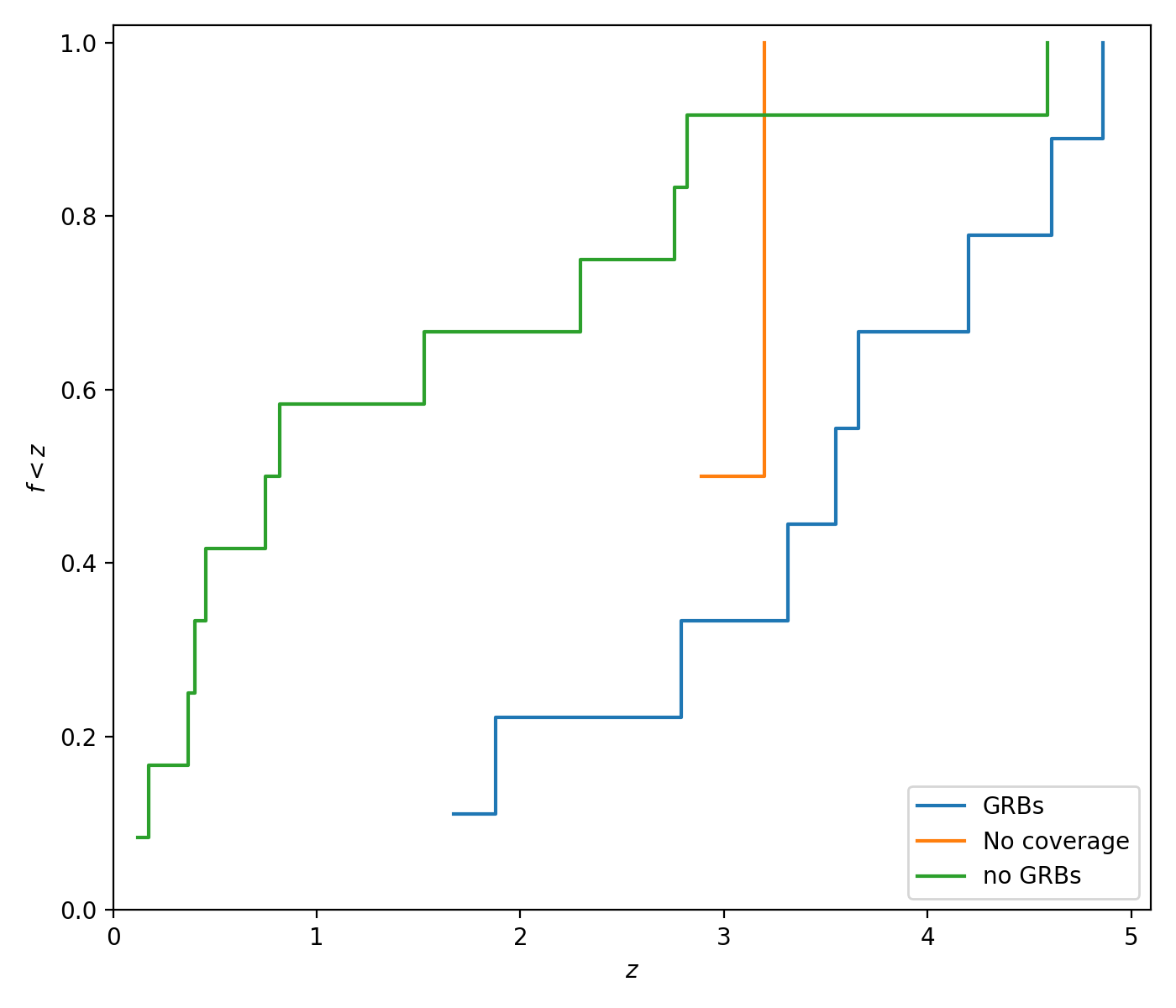
原图说明 (Fig. 12)
- 红移测量不完全(部分源缺乏宿主星系光谱确认)
学术脉络、进展比较与前置建议 Lineage, Context & Progress
自动筛选未建立论文与组内 Work 的科学关系。
- Methods: “Crucially, the GBM flux upper limits were derived over the exact same time interval as the measured X-ray durations of each transient ( and ), ensuring that the -ray”
- Results: “the X-ray duration is a factor of longer than the -ray duration , with a median ratio of 12.”
- Discussion: “The stringest constraints on the position of the peak energy comes from those events with a -ray flux upper limit a factor 1-10 times the X-ray flux, where we can derive keV for =-1 or”
- Discussion: “If the same empirical correlations established for classical GRBs holds also to this regime, the derived upper limits on would correspond to lower initial Lorentz factors for this population.”
- Discussion: “In the scenario of a low-luminosity GRB, the LAT upper limits derived for some of the EP sources provide an additional constraint on the parameter space, disfavouring combinations of low and low within the adopted model”
- Conclusions: “Discriminating between these scenarios is essential to understand both the structure of relativistic jets and the GRB luminosity function at low energies --- two key yet poorly constrained pieces of the GRB puzzle.”
- Additional plots: “Isotropic equivalent energy (\textit{top panel}) and isotropic equivalent luminosity (\textit{bottom panel}) as a function of redshift for the EP transients analysed in this work.”
证据审计与信源材料 覆盖:正文全文 展开核验 ▾
覆盖范围:已检查版本匹配的完整 TeX 正文;版本 arXiv:2610.28734v1
- 📦 arXiv TeX 源码包 位置:Full bodyComplete, revision-matched arXiv TeX source package
sha256:bbb2854247b237d7...
- 未进行独立同行评审或逐项复算。
- 源文件中的图像未进行视觉核对。
原始摘要与来源Original abstract and source
阅读范围与依据Coverage and evidence
实际阅读范围:已检查版本匹配的完整 TeX 正文;版本 arXiv:2610.28734v1;检查材料:Introduction、Methods、Sample selection、Search for counterparts in GBM、Search for counterparts in LAT、Results、GBM、Events with a $gamma$-ray counterpart、Events without a $gamma$-ray counterpart、X-ray to $gamma$-ray flux comparison、LAT、X-ray to GeV spectral energy distribution、Discussion、Constraints on the spectrum、Comparison with the sample of Fermi/GBM GRBs、Constraints on energetics and $Gamma_0$、Implications on the prompt SSC component、Conclusions、Tables、Additional plots。
This guide uses the recorded body material; inspected sections: Introduction, Methods, Sample selection, Search for counterparts in GBM, Search for counterparts in LAT, Results, GBM, Events with a $gamma$-ray counterpart, Events without a $gamma$-ray counterpart, X-ray to $gamma$-ray flux comparison, LAT, X-ray to GeV spectral energy distribution, Discussion, Constraints on the spectrum, Comparison with the sample of Fermi/GBM GRBs, Constraints on energetics and $Gamma_0$, Implications on the prompt SSC component, Conclusions, Tables, Additional plots.
- arXiv body material Full body; Complete, revision-matched arXiv TeX source package
While the connection of Fast X-ray Transients (FXTs) detected by Einstein Probe (EP) with Gamma-ray Bursts (GRBs) is increasingly compelling, most lack gamma-ray counterparts, leaving their relation to GRBs unclear. We performed a systematic search for gamma-ray counterparts to the 72 transients detected by EP in its first year, using targeted searches in Fermi/GBM and Fermi/LAT data, complemented by SVOM/GRM, SVOM/ECLAIRs, Swift/BAT and Konus-Wind. For the visible events without a gamma-ray counterpart, we derived simultaneous flux upper limits in the 10-1000 keV and the 0.1-1 GeV band. We find that 23 events (32%) have a gamma-ray counterpart (seven sub-threshold), while 49 events (68%) have none, despite most being visible. For events with a gamma-ray counterpart, the X-ray flux over the gamma-ray is systematically higher than over the full X-ray duration, with flux ratios , suggesting that gamma-rays are preferentially detected during the brightest X-ray phases. For events without gamma-ray counterpart, the most stringent Fermi/GBM upper limits imply -100 keV and, for the 14 events with measured redshifts, erg/s. If classical GRB correlations hold in this regime, these lower energetics imply lower bulk Lorentz factors (), as confirmed in a few cases by afterglow constraints. No significant GeV emission was detected by Fermi/LAT, yielding , placing the first constraints on a potential synchrotron self-Compton component for this new population. Although individual origins remain uncertain, many EP FXTs could be compatible with the GRB population, extending it toward lower , luminosities, and bulk Lorentz factors.
这里保留 arXiv 提供的原始摘要;它是来源材料,不表示独立验证。
This is the original arXiv abstract used as source material; it does not represent independent verification.
打开 arXiv:2610.28734v1 原文页面Open arXiv:2610.28734v1 source page 在 NASA ADS 查看NASA ADS ↗
Click the button above to view full quantitative analysis and verbatim evidence in dialog.