Collapsars Are Not Heavy $r$-Process Factories 坍缩星并非重 r-过程元素的工厂
课题
探讨坍缩星(collapsar)中微子冷却吸积盘(NDAF)风能否产生重 -过程核素。核心物理矛盾在于:重 -过程要求极低电子丰度(),依赖极高密度和足够长的内流时标以进行电子俘获中子化;而将物质有效抛射需要强磁应力做功解绑,但强磁场会导致内流速度 增加、缩短时标并降低盘密度,从而破坏中子化条件。
突破
坍缩星吸积盘在任何磁通序列下均无法向外抛射电子丰度 的重 -过程气体。在长 GRB 喷流各向同性峰值功率上限 与吸积率 限制下,在有效磁解绑半径 处,气体所能达到的理论最低电子丰度随无量纲磁通参数 变化,从发射喷流阈值处的 单调上升至 MAD 极限下的 。即使采用速率极大化温度,净中子化率积分上限 ,导出严格理论下限 。
理由
文章直面高能瞬变与超新星中心引擎核心争议,利用解析极值与观测能量标度,证明长 GRB 驱动喷流所需的磁应力与合成重 -过程所需的盘内中子化条件存在根本动力学冲突,从物理上排除了坍缩星盘风作为重 -过程主要来源的假设。
Collapsars Are Not Heavy -Process Factories 坍缩星并非重 r-过程元素的工厂
核心课题、机制与切入建议 Problem, Method & Entry
🎯 课题目标 探讨坍缩星(collapsar)中微子冷却吸积盘(NDAF)风能...
探讨坍缩星(collapsar)中微子冷却吸积盘(NDAF)风能否产生重 -过程核素。核心物理矛盾在于:重 -过程要求极低电子丰度(),依赖极高密度和足够长的内流时标以进行电子俘获中子化;而将物质有效抛射需要强磁应力做功解绑,但强磁场会导致内流速度 增加、缩短时标并降低盘密度,从而破坏中子化条件。
⚙️ 方法与机制 结合 Blandford-Znajek 机制喷流功率标度 $P_...
结合 Blandford-Znajek 机制喷流功率标度 (其中 ,)与长 GRB 观测上限,构建了从弱磁通(SANE)到磁阻碍吸积盘(MAD)全磁通序列的吸积流模型。通过在每个半径处选取最大化净中子化率的局域最优温度 ,并利用轻微电子简并展开构造包络速率 ,沿吸积速度 向内积分推导到达解绑半径 处的最小可能 。
💡 建议入口 Failure across the magnetic-flux sequence
物理假设、图表与结果边界 Physical Models, Figures & Results
📐 物理假设
- 外流气体必须在解绑半径 或之外由大尺度磁应力做功实现非束缚。
📊 核心图表
核心物理演化图
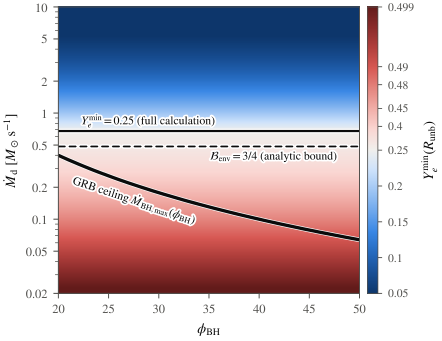
物理核心: 图中给出最小电子分数 在盘吸积率 与黑洞磁通参数 平面上的分布,并与 的重 过程阈值及 GRB 发动机功率上限对应的吸积率上限比较。沿 GRB 上限,所有 下均有 ,直接呈现可实现的坍缩星盘外流难以达到重 过程所需低电子分数的核心约束。
原图说明 (Fig. 3)
Figure 3: Minimum Y e ( R unb ) Y_{\rm e}(R_{\rm unb}) in ( M ˙ d , ϕ BH ) (\dot{M}_{\rm d},\phi_{\rm BH}) . The thin solid (dashed) line shows the Y e = 0.25 Y_{\rm e}=0.25 contour using the numerical (analytic) estimate. The thick line delineates the ceiling of the GRB population: M ˙ BH , max = 0.4 M ⊙ s − 1 ( 20 / ϕ BH ) 2 \dot{M}_{\rm BH,max}=0.4\,M_{\odot}\,{\rm s^{-1}}\,(20/\phi_{\rm BH})^{2} , for P j = 5 × 10 51 erg s − 1 P_{j}=5\times 10^{51}\,{\rm erg\,s^{-1}} , a = 0.3 a=0.3 , and M BH = 3 M ⊙ M_{\rm BH}=3\,M_{\odot} . Along the GRB ceiling, Y e min ≳ 0.33 Y_{\rm e}^{\min}\gtrsim 0.33 for any value of ϕ BH \phi_{\rm BH} .
核心物理演化图
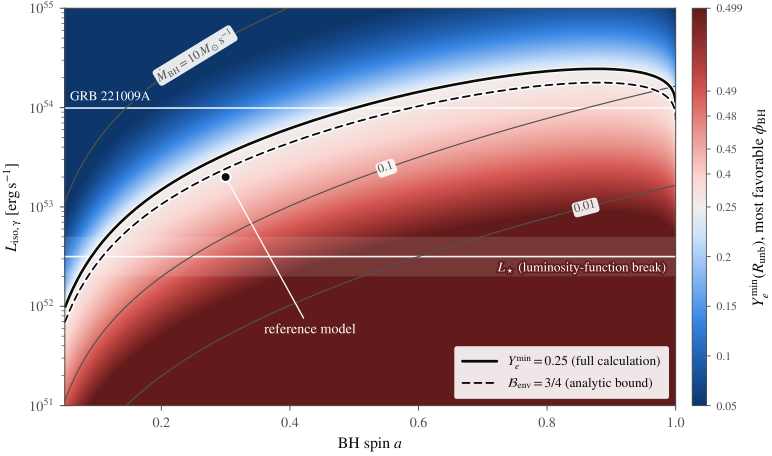
物理核心: 图中展示最有利假设下 随黑洞自旋 和各向同性等效伽马射线光度 的变化,并标出 的边界、GRB 光度函数断点及 GRB 221009A 的峰值光度。它刻画了常见 GRB 发动机与极端高光度事件在达到重 过程所需电子分数方面的差异,同时提示峰值光度可能高估持续喷流功率。
原图说明 (Fig. 4)
Figure 4: Most favorable composition bound as a function of black hole spin a a and isotropic-equivalent γ \gamma -ray luminosity L iso L_{\rm iso} . Colors show Y e min ( R unb ) Y_{\rm e}^{\min}(R_{\rm unb}) derived from Eq. ( 22 ) with η a ( a ) \eta_{a}(a) of Eq. ( 2 ), assuming M BH = 3 M ⊙ M_{\rm BH}=3\,M_{\odot} , θ j = 0.1 \theta_{j}=0.1 , and η γ = 0.2 \eta_{\gamma}=0.2 , and minimizing over 20 ≤ ϕ BH ≤ 50 20\leq\phi_{\rm BH}\leq 50 (minimum is reached at ϕ BH = 20 \phi_{\rm BH}=20 ). The circle marks the ceiling reference model ( a = 0.3 a=0.3 , P j = 5 × 10 51 erg s − 1 P_{j}=5\times 10^{51}\,{\rm erg\,s^{-1}} ), for which Y e min ≈ 0.33 Y_{\rm e}^{\min}\approx 0.33 . The solid curve marks Y e min = 0.25 Y_{\rm e}^{\min}=0.25 from the full numerical calculation and the dashed curve ℬ env = 3 / 4 \mathcal{B}_{\rm env}=3/4 , where the analytic bound of Eq. ( 29 ) reaches Y e = 0.25 Y_{\rm e}=0.25 . Thin gray curves show M ˙ BH ( ϕ BH = 20 ) = 0.01 \dot{M}_{\rm BH}(\phi_{\rm BH}{=}20)=0.01 , 0.1, and 10 M ⊙ s − 1 10\,M_{\odot}\,{\rm s^{-1}} . Horizontal lines mark observed isotropic-equivalent peak luminosities: the break of the long-GRB luminosity function, L ⋆ = 10 52.5 ± 0.2 erg s − 1 L_{\star}=10^{52.5\pm 0.2}\,{\rm erg\,s^{-1}} (line and shaded uncertainty; Wanderman and Piran 103 ) and GRB 221009A ( 9.9 × 10 53 erg s − 1 9.9\times 10^{53}\,{\rm erg\,s^{-1}} ; Lesage et al. 55 ). Peak luminosities overestimate the sustained jet power and hence M ˙ BH \dot{M}_{\rm BH} : GRB 221009A radiated E γ , iso = 1.0 × 10 55 E_{\gamma,\rm iso}=1.0\times 10^{55} erg over more than 600 s at z = 0.151 z=0.151 [ 55 ] , corresponding to a mean luminosity of ≲ 2 × 10 52 erg s − 1 \lesssim 2\times 10^{52}\,{\rm erg\,s^{-1}} . The color scale is linear in Y e min Y_{\rm e}^{\min} below 0.25 (blue) and logarithmic in 0.5 − Y e min 0.5-Y_{\rm e}^{\min} above it (red).
🏁 作者报告的结果与边界 坍缩星吸积盘在任何磁通序列下均无法向外抛射电子丰度 $Y_{\r...
坍缩星吸积盘在任何磁通序列下均无法向外抛射电子丰度 的重 -过程气体。在长 GRB 喷流各向同性峰值功率上限 与吸积率 限制下,在有效磁解绑半径 处,气体所能达到的理论最低电子丰度随无量纲磁通参数 变化,从发射喷流阈值处的 单调上升至 MAD 极限下的 。即使采用速率极大化温度,净中子化率积分上限 ,导出严格理论下限 。
学术脉络、进展比较与前置建议 Lineage, Context & Progress
🔗 组内学术脉络 无组内匹配
自动筛选未建立论文与组内 Work 的科学关系。
📈 进展比较
破除了以往数值模拟中由于低估磁输运速率或假定静态环境而认为坍缩星是重 -过程主要产地的结论,定量证明了长 GRB 喷流能量上限与盘风超重核合成所需的高中子化程度不可兼得,将天体物理重 -过程的发生场所进一步锁定在致密双星并合等事件中。
🔍 引用线索
- Introduction: “Thus, the same magnetic stresses needed to eject neutron-rich gas can also erase the conditions required to produce it.”
- Failure across the magnetic-flux sequence: “The weak-flux/SANE limit corresponds to , below which no jet emerges. Without a jet, the disk launches magnetically driven winds only once it becomes MAD”
- Failure across the magnetic-flux sequence: “Along this ceiling, the minimum attainable electron fraction increases from to .”
- Conclusions: “The basic requirement is that gas must become neutron-rich at the radius outside which magnetic stresses can do enough work per loaded baryon to unbind the gas.”
证据审计与信源材料 覆盖:正文全文 展开核验 ▾
📑 实际阅读范围 正文全文
覆盖范围:已检查版本匹配的完整 TeX 正文;版本 arXiv:2610.31758v1
IntroductionGRB Observational constraintsFailure across the magnetic-flux sequenceWeak-flux/SANE limitSub-MAD/MAD regimeGradual magnetizationImplicationsConclusionsNeutronization along inflow trajectoriesDependence on the outer radiusRate-maximizing temperature$alpha$ particlesNeutrino absorption
📦 信源依据与定位
- 📦 arXiv TeX 源码包 位置:Full bodyComplete, revision-matched arXiv TeX source package
sha256:51ba6504ec024c47...
⏳ 未决核查待办
- 未进行独立同行评审或逐项复算。
- 源文件中的图像未进行视觉核对。
原始摘要与来源Original abstract and source
阅读范围与依据Coverage and evidence
实际阅读范围:已检查版本匹配的完整 TeX 正文;版本 arXiv:2610.31758v1;检查材料:Introduction、GRB Observational constraints、Failure across the magnetic-flux sequence、Weak-flux/SANE limit、Sub-MAD/MAD regime、Gradual magnetization、Implications、Conclusions、Neutronization along inflow trajectories、Dependence on the outer radius、Rate-maximizing temperature、$alpha$ particles、Neutrino absorption。
This guide uses the recorded body material; inspected sections: Introduction, GRB Observational constraints, Failure across the magnetic-flux sequence, Weak-flux/SANE limit, Sub-MAD/MAD regime, Gradual magnetization, Implications, Conclusions, Neutronization along inflow trajectories, Dependence on the outer radius, Rate-maximizing temperature, $alpha$ particles, Neutrino absorption.
- arXiv body material Full body; Complete, revision-matched arXiv TeX source package
Collapsar disks are proposed sources of -process elements, but neutron-rich disk ejecta require gas to be both neutronized in the disk and ejected before accretion. The magnetic field that enables ejection also thickens the disk and accelerates the inflow, lowering both the density and the time available for weak processing. To compute the resulting neutronization, we evolve the electron fraction of the inflowing gas, adopting at each radius the temperature that maximizes the net neutronization rate for the local density and instantaneous composition. This yields a lower limit on that is independent of the disk's thermal history. We adopt an optimistic unbinding radius of for all magnetic fluxes capable of launching outflows. Combining this ejection condition with favorable assumptions of low black hole mass, ejection of midplane gas, and the upper end of the -ray burst (GRB) engine-power scale, which limits the accretion rate to , gives a fiducial lower bound , above the characteristic threshold for heavy -process production. Stronger magnetic flux, toward which jet-launching engines evolve, raises the lower bound to . We conclude that collapsar disk outflows cannot supply the heavy -process yields invoked for a dominant enrichment channel. Only engines with unusually high accretion rates, potentially including exceptionally luminous GRBs, such as GRB 221009A, and direct-horizon collapsars, may produce heavy -process ejecta.
这里保留 arXiv 提供的原始摘要;它是来源材料,不表示独立验证。
This is the original arXiv abstract used as source material; it does not represent independent verification.
打开 arXiv:2610.31758v1 原文页面Open arXiv:2610.31758v1 source page 在 NASA ADS 查看NASA ADS ↗
Click the button above to view full quantitative analysis and verbatim evidence in dialog.