EP241021a as An Off-nuclear Month-duration Transient in a Dwarf Starburst Galaxy
Problem
Accounting for the multi-epoch optical rebrightenings (at with amplitude and at ), the -month flat X-ray plateau, and the subsequent coordinated steep drop at , which break standard single-jet core-collapse supernova and compact binary merger models whose central engines shut down on timescales .
Result
EP241021a (, , ) occurred at a projected offset of () from the nucleus of an edge-on dwarf starburst galaxy (, , effective radius ). The host-subtracted optical transient underwent a rapid break/drop at observer-frame (rest-frame ) at , synchronized with the X-ray light-curve steep decline. The month-long accretion timescale and off-nuclear site exclude both standard core-collapse supernova engines and supermassive black holes, favoring an intermediate-mass black hole () or a stellar-mass compact object micro-TDE undergoing repeating partial disruptions.
Reason
This paper presents critical deep HST and Gemini-N follow-up of the peculiar fast X-ray transient EP241021a, uncovering a sharp synchronous optical/X-ray drop at and an off-nuclear location () in a dwarf starburst galaxy, which directly constrains relativistic jet shut-off and long-duration non-SMBH tidal disruption engines.
EP241021a as An Off-nuclear Month-duration Transient in a Dwarf Starburst Galaxy
Problem, Method & Entry
🎯 Problem Accounting for the multi-epoch o...
Accounting for the multi-epoch optical rebrightenings (at with amplitude and at ), the -month flat X-ray plateau, and the subsequent coordinated steep drop at , which break standard single-jet core-collapse supernova and compact binary merger models whose central engines shut down on timescales .
⚙️ Method Multi-band high-resolution imagi...
Multi-band high-resolution imaging using HST/WFC3 (F606W, F814W, F110W, F160W) and Gemini-N/GMOS () combined with Gaia DR3 absolute astrometric calibration (galaxy centroid uncertainty ) to measure the offset relative to VLBA coordinates; host-galaxy SED modeling via CIGALE to constrain , , age, and extinction; and host-subtracted light curve modeling parameterizing the post-break drop as jet cessation driven by cessation of accretion.
💡 Entry IV Discussion
Physical Models, Figures & Results
📊 Key Figures
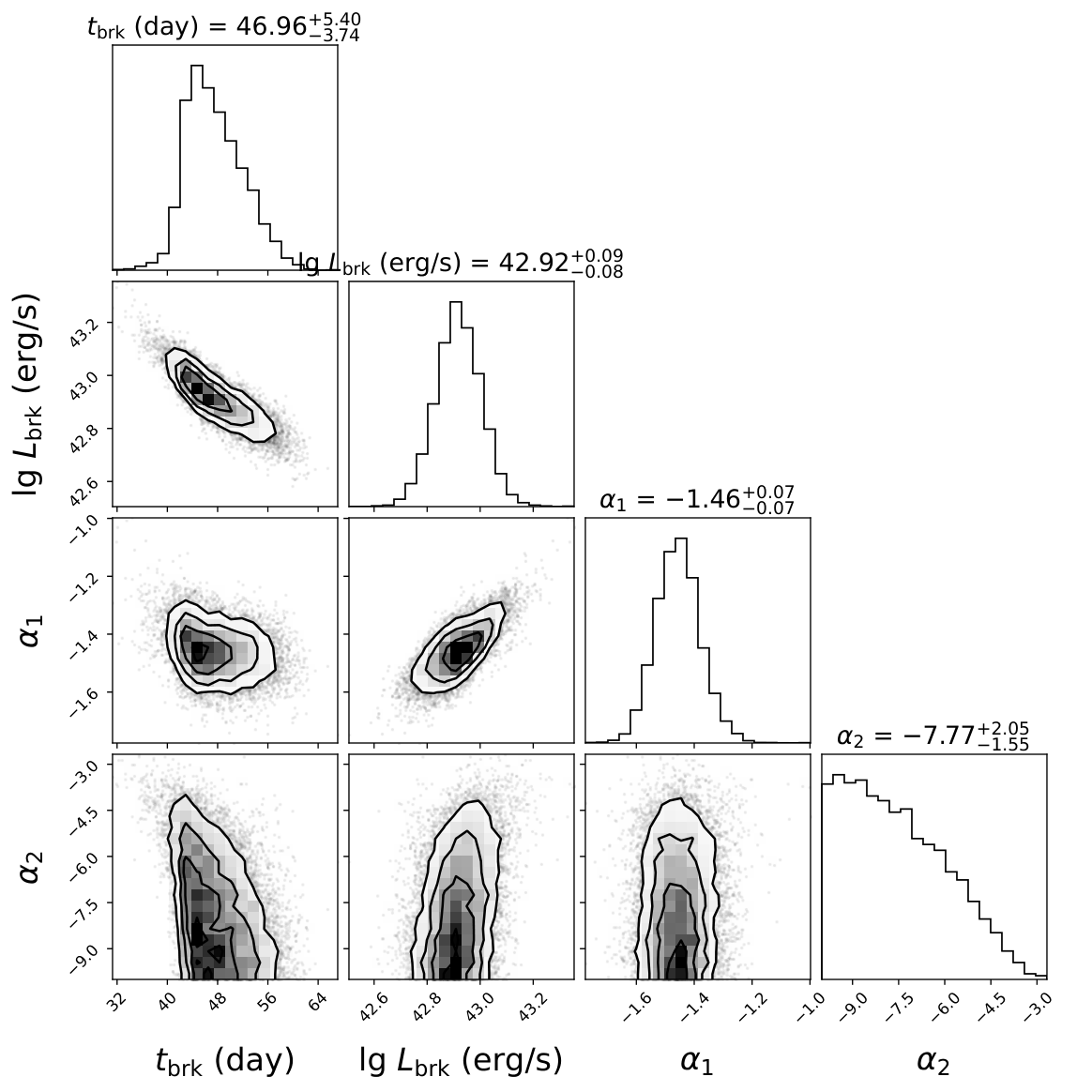
Model vs Data Fitting
Physical Core: Comparison between theoretical models and observational data with posterior parameter constraints.
Caption (Fig. 3)
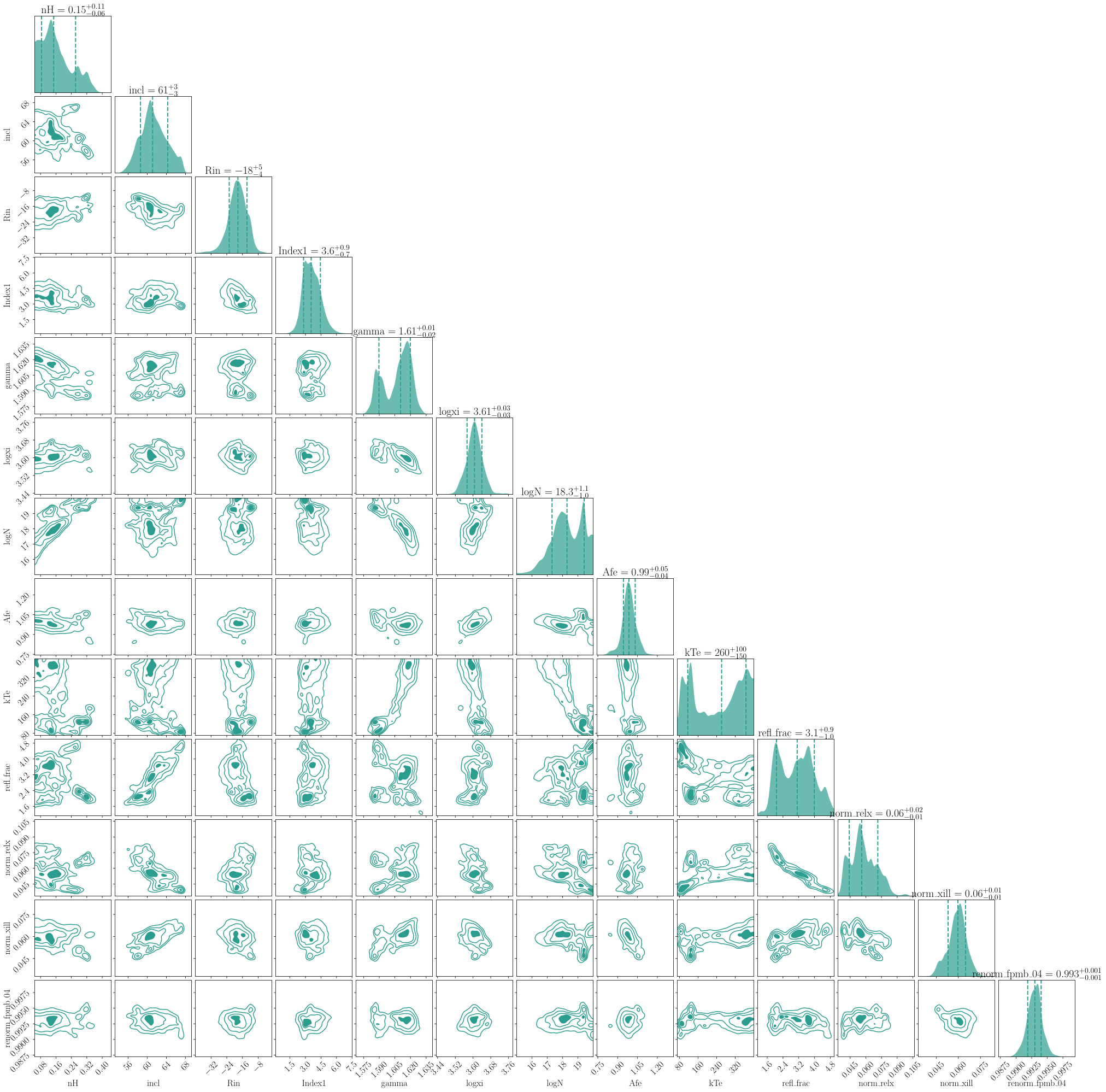
Figure 3: (a): The host-subtracted optical light curves of the transient EP241021a in the and bands, along with the X-ray light curves during and after the plateau phase. The data were taken from [ 43 ] and [ 9 ]. The rebrightening, the subsequent power-law decay, and the final sharp decline are labeled in both bands. (b): The broken power-law models that fit the -band data after a phase of 7.5 days. We present 200 randomly selected MCMC realizations for clarity. (c): The posterior distributions for each model parameter.
🏁 Author-reported results and limits EP241021a
EP241021a (, , ) occurred at a projected offset of () from the nucleus of an edge-on dwarf starburst galaxy (, , effective radius ). The host-subtracted optical transient underwent a rapid break/drop at observer-frame (rest-frame ) at , synchronized with the X-ray light-curve steep decline. The month-long accretion timescale and off-nuclear site exclude both standard core-collapse supernova engines and supermassive black holes, favoring an intermediate-mass black hole () or a stellar-mass compact object micro-TDE undergoing repeating partial disruptions.
Lineage, Context & Progress
📈 Research Progress
Establishes that EP241021a is an off-nuclear relativistic transient powered by month-long accretion rather than a collapsar or BNS merger engine, providing strong empirical evidence that fast X-ray transients can be produced by non-SMBH tidal disruption events (IMBH rpTDE or micro-TDE) with late-time jet shut-off.
🔍 Citation Leads
- EP241021a as An Off-nuclear Month-duration Transient in a Dwarf Starburst GalaxyFacilities: HST(WFC3), Gemini-N(GMOS): “EP241021a is a peculiar fast X-ray transient exhibiting a long X-ray plateau and an optical rebrightening, both challenging the traditional jet afterglow model.”
- II Observation and data reduction: “The root mean square (rms) of the four offsets was adopted as the systematic error.”
- V Conclusion: “This sharp decline, together with the synchronous drop in the X-ray light curve, points to jet shut-off, which in turn requires a month-long accretion and thus favors TDE interpretations.”
Evidence Audit & Source Material Coverage: full body Audit Details ▾
📑 Scope full body
Coverage: 已检查版本匹配的完整 TeX 正文; version arXiv:2610.34217v1
IntroductionEP241021a as An Off-nuclear Month-duration Transient in a Dwarf Starburst GalaxyFacilities: HST(WFC3), Gemini-N(GMOS)I IntroductionII Observation and data reductionIII Data analysis and resultsIII.1 HST imageIII.2 Spectral energy distribution of the host galaxyIII.3 Host-subtracted optical light curve of the transientIV DiscussionIV.1 Optical and X-ray drop: jet shut-off?IV.2 Candidate models and observational constraintsIV.2.1 SN with a single jet?IV.2.2 IMBH repeating partial TDEs?IV.2.3 Micro-TDE?V ConclusionReferencesInstructions for reporting errors
📦 Source Evidence
- 📦 arXiv TeX Source Package Locator: Full bodyComplete, revision-matched arXiv TeX source package
sha256:a7a6ccd6769c68f5...
⏳ Unresolved Checks
- No independent peer review or line-by-line recalculation performed.
- Figures from source package have not undergone visual verification.
Original abstract and source
Coverage and evidence
This guide uses the recorded body material; inspected sections: Introduction, EP241021a as An Off-nuclear Month-duration Transient in a Dwarf Starburst GalaxyFacilities: HST(WFC3), Gemini-N(GMOS), I Introduction, II Observation and data reduction, III Data analysis and results, III.1 HST image, III.2 Spectral energy distribution of the host galaxy, III.3 Host-subtracted optical light curve of the transient, IV Discussion, IV.1 Optical and X-ray drop: jet shut-off?, IV.2 Candidate models and observational constraints, IV.2.1 SN with a single jet?, IV.2.2 IMBH repeating partial TDEs?, IV.2.3 Micro-TDE?, V Conclusion, References, Instructions for reporting errors.
- arXiv body material Full body; Complete, revision-matched arXiv TeX source package
EP241021a is a peculiar fast X-ray transient exhibiting a long X-ray plateau and an optical rebrightening, both challenging the traditional jet afterglow model. Whether its nature is a stellar explosion or a tidal disruption event (TDE) remains debated. Here we present late-time HST/WFC3 and Gemini-N/GMOS observations of its host galaxy at . After days post-trigger, the transient emission had faded below detection, revealing a dwarf disk galaxy with an effective radius kpc, a stellar mass , and a high star formation rate of . Combined with previous very long baseline interferometry measurements, the transient can be located in the galactic disk with a projected physical offset of kpc from the galaxy center. Host-subtracted optical light curves show that the rebrightening ceased at days, followed by a sudden drop with a power-law index steeper than , coincident with a similar drop in the X-ray light curve. This synchronous drop in both bands is consistent with jet shut-off, and the required month-long jet activity suggests a persistently accreting compact object fed by a TDE. Among the TDE scenarios, the off-nuclear location and the starburst host galaxy slightly favor the post-supernova micro-TDE scenario in a binary system, in which a natal kick drives the newborn compact object into a tidal disruption of its companion. Nevertheless, an off-nuclear intermediate-mass black hole TDE or a stellar-mass black hole TDE induced by dynamical scattering in a dense stellar cluster cannot yet be excluded.
This is the original arXiv abstract used as source material; it does not represent independent verification.
Click the button above to view full quantitative analysis and verbatim evidence in dialog.