Discovery of a New Electron Spectrum Produced by Fast Cooling of Relativistic Electrons
Problem
In astrophysical relativistic jets such as GRBs and blazars, electrons below the minimum injection Lorentz factor evolve in a non-steady state, causing their energy distribution to deviate significantly from the canonical steady-state power law .
Result
In the fast-cooling regime below the minimum injection Lorentz factor (), the time-evolving cooled electron spectrum follows the smooth broken power-law form , scaling asymptotically as for and for . For pure synchrotron cooling with and injection rate , , , and ; with adiabatic cooling included (expansion ), and .
Reason
The paper provides an analytical, unified fast-cooling electron spectrum for non-steady relativistic jet systems (GRBs, blazars), solving the long-standing discrepancy from the standard steady-state distribution below .
Discovery of a New Electron Spectrum Produced by Fast Cooling of Relativistic Electrons
Problem, Method & Entry
🎯 Problem In astrophysical relativistic je...
In astrophysical relativistic jets such as GRBs and blazars, electrons below the minimum injection Lorentz factor evolve in a non-steady state, causing their energy distribution to deviate significantly from the canonical steady-state power law .
⚙️ Method Analytical kinetic integration a...
Analytical kinetic integration and differential equation solving of electron cooling trajectories combined with exact verification against the source-free Fokker-Planck equation for .
💡 Entry II.1 Analytical Derivation of
Physical Models, Figures & Results
📐 Assumptions
- Conical flow expanding radially with a constant bulk Lorentz factor for adiabatic cooling
- Continuous relativistic electron injection occurs only above with a power-law distribution
📊 Key Figures
Physical Evolution
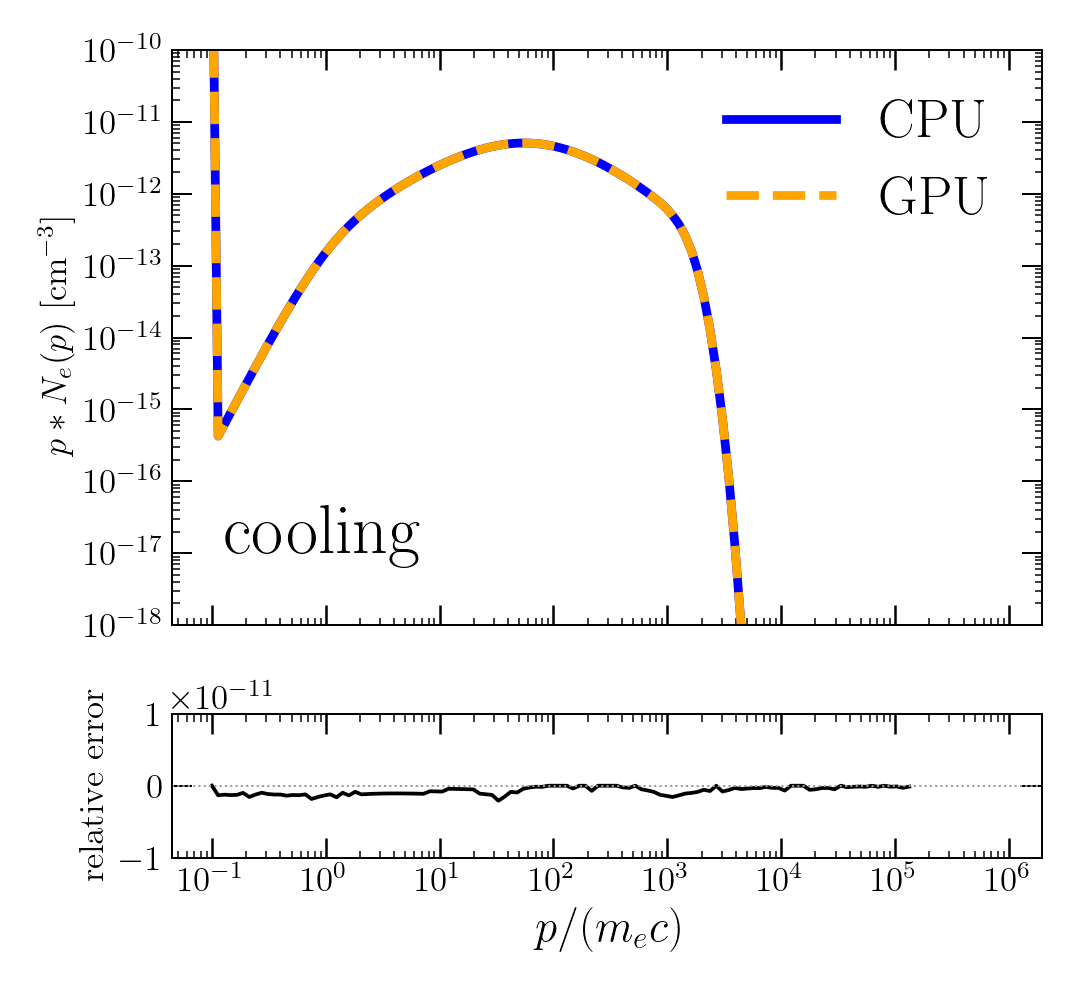
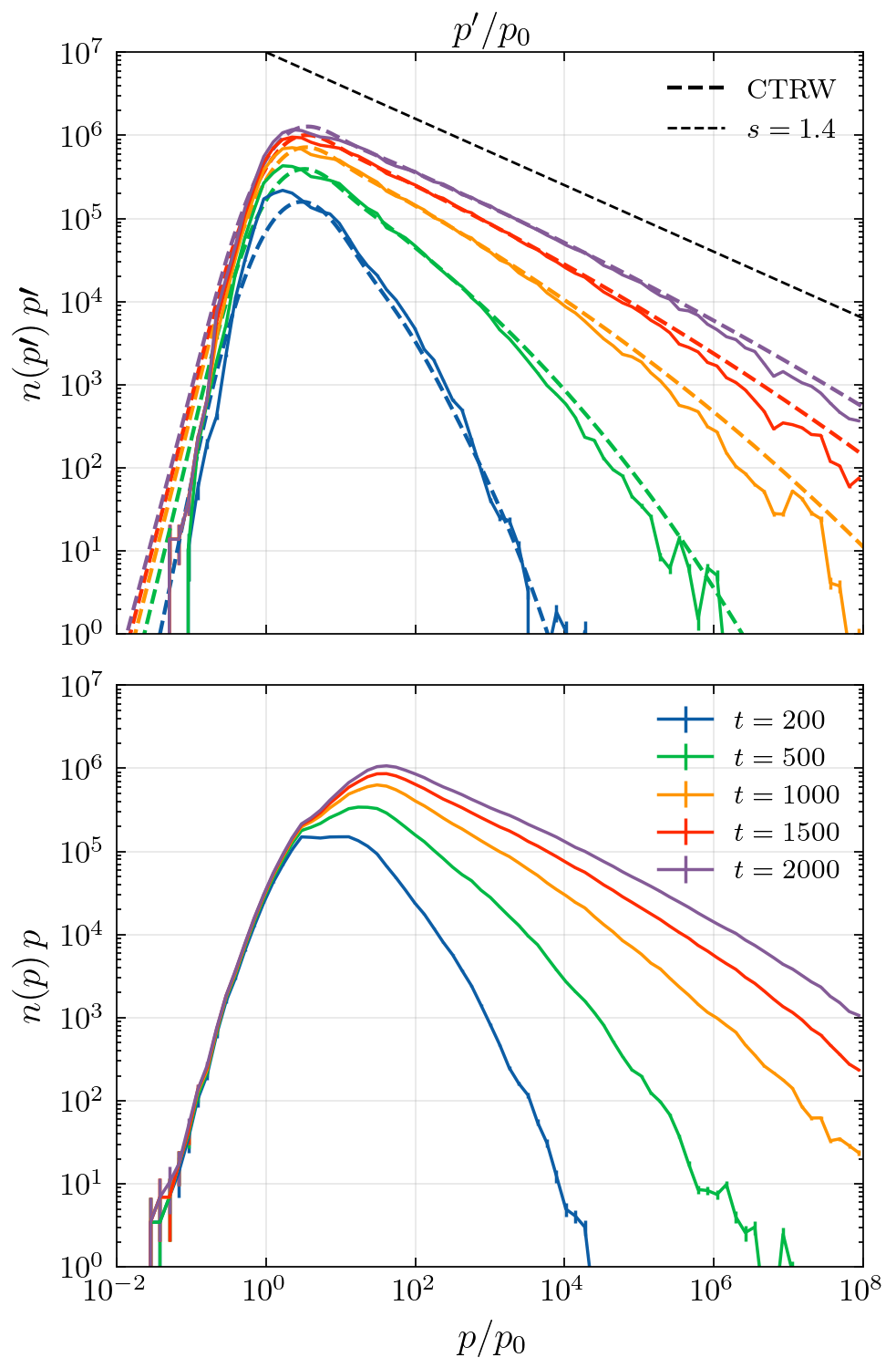
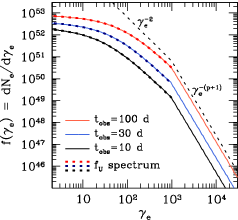
Physical Core: Compares the proposed fast-cooled electron spectrum with a detailed numerical blazar electron-spectrum calculation as a function of observer time, for a model with .
Caption (Fig. 1)
Figure 1: Comparison of our electron spectrum (thick-dotted lines) to a detailed numerical calculation of a blazar electron spectrum (solid lines) as a function of observer time . The solid lines show the model [a] presented in [ 24 ]. The model [a] has a minimum injection Lorentz factor .
🏁 Author-reported results and limits In the fast-cooling regime below...
In the fast-cooling regime below the minimum injection Lorentz factor (), the time-evolving cooled electron spectrum follows the smooth broken power-law form , scaling asymptotically as for and for . For pure synchrotron cooling with and injection rate , , , and ; with adiabatic cooling included (expansion ), and .
Lineage, Context & Progress
📈 Research Progress
Replaces the heuristic/steady-state prescription with an exact time-dependent analytical solution below , proving that the characteristic cooling scale is decoupled from the injection history while the low-energy slope captures the injection and expansion dynamics.
🔍 Citation Leads
- Discovery of a New Electron Spectrum Produced by Fast Cooling of Relativistic Electrons: “In general, the cooled electrons below evolve in a non-steady state and their spectrum deviates significantly from the power-law . We present here a new electron spectrum that describes this”
- II.1.2 Radiative and Adiabatic Cooling: “where the second term on the right-hand side describes the adiabatic cooling for a conical flow expanding radially with a constant bulk Lorentz factor.”
- III Application to Blazars: “The electron injection occurs only above and has a power-law distribution .”
- IV Conclusion and Discussion: “We presented a new electron spectrum produced by cooling of relativistic electrons in the fast-cooling regime. We showed that the spectrum gives us a general electron spectrum to describe the entire cooled”
Evidence Audit & Source Material Coverage: full body Audit Details ▾
📑 Scope full body
Coverage: 已检查版本匹配的完整 TeX 正文; version arXiv:2610.37044v1
IntroductionDiscovery of a New Electron Spectrum Produced by Fast Cooling of Relativistic ElectronsI IntroductionII New Electron SpectrumII.1 Analytical Derivation of $frm U$II.1.1 Radiative CoolingII.1.2 Radiative and Adiabatic CoolingII.2 Validity of $frm U$ for all $gammae<gammam$II.2.1 Radiative CoolingII.2.2 Radiative and Adiabatic CoolingII.3 Consistency CheckII.3.1 Radiative CoolingII.3.2 Radiative and Adiabatic CoolingII.4 Generalization of $frm U$ to Evolving $beta$III Application to BlazarsIV Conclusion and DiscussionReferencesInstructions for reporting errors
📦 Source Evidence
- 📦 arXiv TeX Source Package Locator: Full bodyComplete, revision-matched arXiv TeX source package
sha256:7297a9317fe4a1a5...
⏳ Unresolved Checks
- No independent peer review or line-by-line recalculation performed.
- Figures from source package have not undergone visual verification.
Original abstract and source
Coverage and evidence
This guide uses the recorded body material; inspected sections: Introduction, Discovery of a New Electron Spectrum Produced by Fast Cooling of Relativistic Electrons, I Introduction, II New Electron Spectrum, II.1 Analytical Derivation of $frm U$, II.1.1 Radiative Cooling, II.1.2 Radiative and Adiabatic Cooling, II.2 Validity of $frm U$ for all $gammae<gammam$, II.2.1 Radiative Cooling, II.2.2 Radiative and Adiabatic Cooling, II.3 Consistency Check, II.3.1 Radiative Cooling, II.3.2 Radiative and Adiabatic Cooling, II.4 Generalization of $frm U$ to Evolving $beta$, III Application to Blazars, IV Conclusion and Discussion, References, Instructions for reporting errors.
- arXiv body material Full body; Complete, revision-matched arXiv TeX source package
In energetic astrophysical sources like the gamma-ray bursts (GRBs) and blazars, the relativistic electrons lose their energy efficiently through synchrotron radiation and inverse Compton (IC) scattering and can rapidly cool to energies below the minimum acceleration energy . It is widely known that such electrons develop a power-law spectrum below . However, this power-law spectrum is valid only if a steady-state population of electrons is assumed. In general, the cooled electrons below evolve in a non-steady state and their spectrum deviates significantly from the power-law . We present here a new electron spectrum that describes this fast-cooled, generally-evolving, and non-steady-state population of electrons below . We consider two cooling cases: (1) when the electrons undergo radiative (i.e., synchrotron + IC) cooling, and (2) when the electrons experience both radiative and adiabatic cooling. We first derive analytically and find an explicit expression of for each cooling case. Secondly, we show that is a solution to a Fokker-Planck equation in the entire energy range below and derive a general version of for each cooling case. We also compare to a detailed numerical calculation of a blazar electron spectrum and find an excellent agreement for the whole energy range below . Thus, gives us a general electron spectrum to describe the entire cooled electrons below . Our discovery of a new fast-cooling solution below may find it applicable in a wide range of energetic phenomena in high-energy astrophysics.
This is the original arXiv abstract used as source material; it does not represent independent verification.